

Static and default methods in interfaces
Why Java 8 added default and static interface methods, the class-wins and most-specific-wins resolution rules, X.super calls, diamond cases, private helpers, Object-method limits and binary compatibility traps.
On this page
🧩 What are default and static interface methods?
Since Java 8, an interface can contain methods with bodies. A default method is an instance method that every implementing class inherits unless it overrides it; a static method belongs to the interface itself and is called as Interface.method(). For example, Collection gained default Stream<E> stream() in Java 8, so every existing List and Set in the world got streams without a single implementation changing.
This topic sits right where interviewers like to dig. The surface question is easy ("what's a default method?"), and then come the follow-ups: which method runs when a superclass and an interface both provide one, what happens with two interfaces that disagree, why can't a default method override equals, and why Impl.staticMethod() doesn't compile when it would for a class. Those rules are short, but candidates who memorised "interfaces have no code" stumble on every one of them.
What you’ll learn
- Why Java 8 needed default methods to add
stream()andforEach()to existing collections - The three resolution rules: class wins, most specific interface wins, otherwise override and use
A.super.m() - How the three diamond shapes resolve, and why Java never inherits state twice
- Why static interface methods are not inherited and where
privateinterface methods help - Why a default can't override
equals,hashCodeortoString - How a new default can break already compiled classes with
IncompatibleClassChangeError
For this lesson, we'll focus on why Java 8 added default and static methods, the three resolution rules and the X.super.m() syntax, the diamond cases, static methods not being inherited, private helpers, and the binary-compatibility trap that can turn a library upgrade into a runtime error.
Below the line (out of scope)
- Interface basics and implicit modifiers: covered in Interfaces in Java
- Lambdas and
@FunctionalInterface: covered in Functional interfaces in Java - Method dispatch in general: covered in Method overloading and overriding
The 30-second answer
Java 8 added default methods so interfaces could evolve: Collection.stream(), Iterable.forEach() and List.sort() were added without breaking every implementation. Conflicts follow three rules: the class wins (any method from the superclass chain beats a default), then the more specific interface wins (a sub-interface's override beats its parent's), and otherwise the class must override the method and can pick one with A.super.m(). Static interface methods are utility or factory methods like Comparator.comparing and List.of; they're not inherited, so you always call them through the interface name. Java 9 added private methods to share code between defaults. A default can't override equals, hashCode or toString, and adding defaults is binary compatible but can still create conflicts in classes compiled earlier.
Interview radar
Asked very often: Expect the interviewer to ask why Java added default methods, which body wins in a diamond, and why static interface methods are called on the interface name.
Senior rounds probe: Senior rounds probe Object method restrictions, X.super.m() limits, abstract superclass methods winning over defaults, and binary-compatible upgrades that still fail at runtime.
Production angle: In production this appears when a published interface evolves and a harmless-looking default method collides with another library or is too slow for a concrete collection.
01Picture it first: a franchise manual with house rules
Think of a restaurant franchise. Head office sends every outlet a manual: "greet customers like this, plate the dessert like that". An outlet can follow the manual or write its own version of any step. If the outlet's owner already has a rule for that step, the owner's rule wins, because the outlet is the one actually doing the work. If two head offices (say a food franchise and a coffee franchise sharing one shop) send conflicting rules for the same step, the shop owner has to decide, and can say "for this one, I'll follow the coffee manual".
That's the default-method model. The interface ships a default body; the class can override it; the class's own hierarchy wins over any interface; and when two interfaces clash, the class must decide explicitly. The flowchart below is the whole resolution algorithm, and it's worth being able to draw it from memory.
A decision flowchart for which method body runs: if the class or any superclass declares the method, that wins; otherwise if one interface's version overrides all the others, the most specific interface wins; otherwise compilation fails until the class overrides the method, optionally delegating with A.super.m()
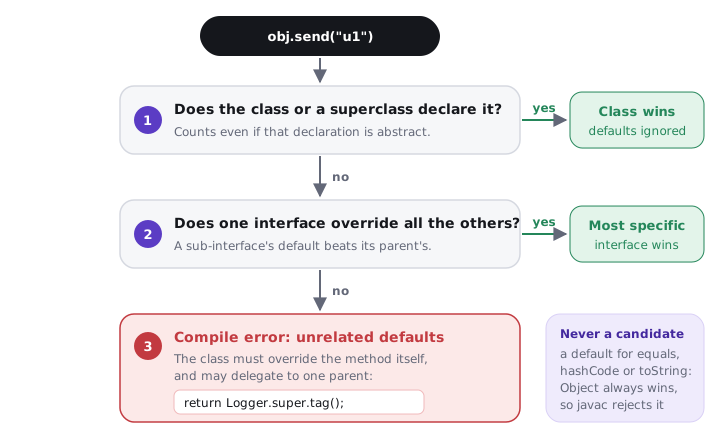
Notice that the first question is about classes, including abstract methods in a superclass. Interfaces only get a say once the class hierarchy has nothing to offer.
02Default and static methods under the hood
Why Java 8 needed them
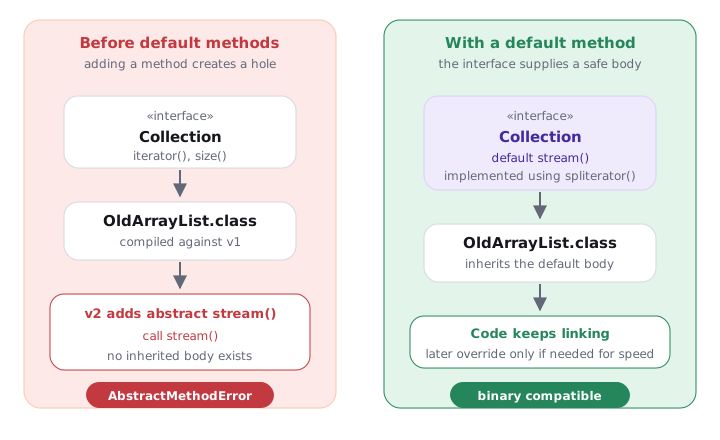
Before Java 8, adding a method to a published interface broke every implementation: class MyList implements List would stop compiling, and an old compiled MyList.class would throw AbstractMethodError the first time someone called the new method. That made lambdas almost unusable, because the whole point was to write orders.stream().filter(...) and orders.forEach(...) on collections that already existed. Default methods let the JDK add stream(), forEach(), removeIf(), List.sort(), Map.getOrDefault(), Map.computeIfAbsent() and dozens more, each with a body written in terms of methods every implementation already had.
// Roughly how the JDK declares it (simplified)
public interface Collection<E> extends Iterable<E> {
    Iterator<E> iterator();
    int size();

    default Stream<E> stream() {
        return StreamSupport.stream(spliterator(), false);
    }

    default boolean removeIf(Predicate<? super E> filter) {
        boolean removed = false;
        for (Iterator<E> it = iterator(); it.hasNext(); ) {
            if (filter.test(it.next())) { it.remove(); removed = true; }
        }
        return removed;
    }
}
The default removeIf works for any collection through iterator(), and ArrayList overrides it with a faster array-based version. That's the pattern: a correct default in terms of the abstract methods, and optional overrides for speed.
The diagram below shows why adding a default method changed interface evolution from a breaking change into a compatible upgrade.
A published interface before Java 8 breaks existing implementers when a method is added, while Java 8 and later can add a default body so old implementers keep linking and may override later
The three resolution rules in code
Try it yourself first
Before reading on, predict what each of the three send/tag calls returns. Then decide which class would fail to compile if you deleted its override.
interface Notifier {
    default String send(String userId) { return "email to " + userId; }
}
interface SmsNotifier extends Notifier {
    @Override default String send(String userId) { return "sms to " + userId; }
}
class BaseService {
    public String send(String userId) { return "base to " + userId; }
}

class OrderService extends BaseService implements Notifier {}     // rule 1: class wins
class AlertService implements Notifier, SmsNotifier {}            // rule 2: more specific wins

interface Logger  { default String tag() { return "log"; } }
interface Metrics { default String tag() { return "metrics"; } }
class Telemetry implements Logger, Metrics {                      // rule 3: must override
    @Override public String tag() {
        return Logger.super.tag() + "+" + Metrics.super.tag();
    }
}

System.out.println(new OrderService().send("u1"));   // prints: base to u1
System.out.println(new AlertService().send("u1"));   // prints: sms to u1
System.out.println(new Telemetry().tag());           // prints: log+metrics
Notice three things:
- Rule 1, class wins.
OrderServiceinheritssendfromBaseServiceand a default fromNotifier. The superclass method wins, even thoughBaseServicehas nothing to do withNotifier. This rule also applies to abstract superclass methods: ifBaseService.sendwereabstract,OrderServicewould have to implement it, and the default wouldn't fill the gap. - Rule 2, more specific interface wins.
SmsNotifierextendsNotifierand overridessend, so forAlertServicetheSmsNotifierversion is "more specific". ListingNotifierexplicitly in theimplementsclause changes nothing. - Rule 3, explicit choice.
LoggerandMetricsare unrelated. DeleteTelemetry.tag()andjavacreportstypes Logger and Metrics are incompatible; class Telemetry inherits unrelated defaults for tag() from types Logger and Metrics. TheLogger.super.tag()syntax calls a specific interface's default, and it compiles toinvokespecialon anInterfaceMethodreference.
X.super.m() has two restrictions interviewers like. X must be a direct superinterface of the class, and you can't use it to skip past a more specific override: if class Q implements PushNotifier, Notifier and PushNotifier overrides Notifier's default, then Notifier.super.send(...) fails with bad type qualifier Notifier in default super call.
Premium lesson
Keep reading with the Java Pass
The rest of this lesson is part of Java One-Stop Interview Prep: in-depth explanations, diagrams, model answers and how to say them in the interview.
- Real world: evolving a published interface
- Advanced: the rules that trip people up
- How to say it in the interview
From ₹199 · one-time payment · No auto-renewal
Further reading (7)
- JLS §9.4 Method Declarations (default, static and private interface methods)
- JLS §8.4.8 Inheritance, Overriding, and Hiding
- JLS §13.5.6 Interface Method Declarations (binary compatibility)
- The Java Tutorials: Default Methods
- JEP 431: Sequenced Collections
- Effective Java, 3rd ed., Item 21: Design interfaces for posterity
- Baeldung: Static and Default Methods in Interfaces in Java