

Optional in stream pipelines
Optional in stream pipelines: Optional-returning terminals, filtering Stream<Optional<T>>, OptionalInt and OptionalDouble, lazy fallbacks, null elements and collectors that return Optional.
On this page
🧭 What is Optional in a stream pipeline?
Optional in a stream pipeline is the 0-or-1 result you get from operations that may not produce a value, or the 0-or-1 container you need to flatten while streaming. orders.stream().max(comparing(Order::total)) returns an Optional<Order> because an empty order list has no largest order. It acts like a turnstile with one person allowed through at most: sometimes one value exits, sometimes nobody does.
For this lesson, we'll focus on the stream angle: terminal operations that return Optional, converting Stream<Optional<T>> to Stream<T>, lookup methods that return Optional, primitive optionals, null elements, lazy fallbacks and collectors such as maxBy. We will not re-teach Optional basics, factories or general anti-patterns from the ground up. If you want the full API tour first, read A guide to Java Optional and come back here.
Below the line (out of scope)
- Stream
filter,mapandflatMapmechanics: filter, map and flatMap - Short-circuiting and encounter order: findFirst vs findAny and short-circuiting
- General Optional design rules: A guide to Java Optional
- Collectors in depth: Collectors deep dive and groupingBy and partitioningBy in depth
The 30-second answer
Streams use Optional when a terminal operation may have no answer: findFirst, findAny, min, max and one-argument reduce. Primitive streams return OptionalInt, OptionalLong or OptionalDouble for the same reason, for example IntStream.max() and IntStream.average(). For a Stream<Optional<T>>, Java 8 uses .filter(Optional::isPresent).map(Optional::get), while since Java 9 the clean default is .flatMap(Optional::stream). Since Java 16, mapMulti can do the same without creating tiny streams, but I reach for it only on hot paths or when the callback style reads better. Keep fallbacks lazy with orElseGet or or, use orElseThrow at boundaries where absence is an error, and keep Optional out of fields, parameters and collection elements unless the pipeline is immediately flattening it.
What you’ll learn
- Explain why
findFirst,findAny,min,maxand one-argumentreducereturn Optional - Turn a
Stream<Optional<T>>intoStream<T>with Java 8filterplusget, Java 9Optional::stream, and Java 16mapMulti - Use
Optional.map,flatMap,filter,or,ifPresentOrElse,orElseGetandorElseThrowwithout re-teaching Optional basics - Handle
OptionalInt,OptionalLongandOptionalDoublefrom primitive streams, includingaverage() - Avoid the
orElse(expensiveCall())eager-evaluation trap inside stream code - Recognize null-element stream traps,
Stream.ofNullable, andfilter(Objects::nonNull) - Unwrap
Collectors.maxByresults insidegroupingBywithcollectingAndThen
Interview radar
Asked very often: How do you filter a Stream<Optional<T>> in Java 8 versus Java 9+?
Core follow-up: Which stream terminal operations return Optional, and why does findFirst throw when the first element is null?
Production angle: A lookup pipeline calls orElse(fetchFromRemote()), so the remote call runs even for every cache hit.
01Picture it first: a security line with empty envelopes
Picture a security line where every traveler hands over an envelope. Some envelopes contain a boarding pass, and some are empty because the lookup failed. A stream pipeline can either carry the envelopes all the way down the line, or open each envelope and let only real boarding passes continue.
That is the main move. Flatten the optional at the point where the stream needs values, not ten steps later after every operation has learned to deal with emptiness.
A stream of Optional envelopes flows through flatMap Optional stream so present customers continue and empty envelopes disappear before email extraction
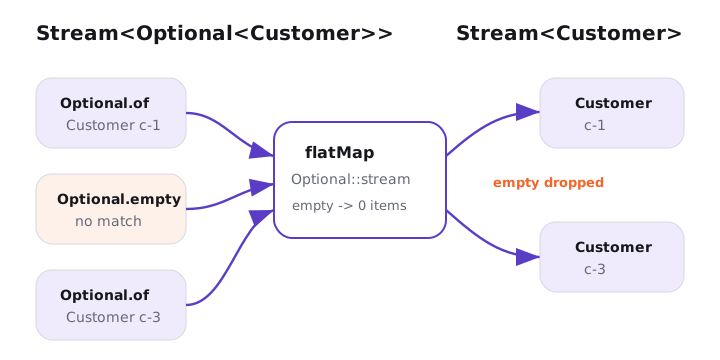
Notice the two different shapes. Before flattening, each element is Optional<Customer>. After flattening, each element is Customer, so the rest of the pipeline is ordinary stream code.
02Optional-returning terminals under the hood
The stream terminals that return Optional all share one reason: the stream might be empty. There may be no first element, no maximum, no minimum and no pair of values to reduce.
Try it yourself first
Before reading on, predict the type and output for each terminal. Which ones are empty?
import java.util.Comparator;
import java.util.List;
import java.util.Optional;

record Order(String id, int totalCents) { }

public class OptionalTerminalsDemo {
    public static void main(String[] args) {
        List<Order> orders = List.of(
                new Order("o-1", 1200),
                new Order("o-2", 2900),
                new Order("o-3", 700)
        );
        List<Order> none = List.of();

        Optional<Order> first = orders.stream().findFirst();
        Optional<Order> biggest = orders.stream()
                .max(Comparator.comparingInt(Order::totalCents));
        Optional<Integer> sum = orders.stream()
                .map(Order::totalCents)
                .reduce(Integer::sum);
        Optional<Order> emptyMax = none.stream()
                .max(Comparator.comparingInt(Order::totalCents));

        System.out.println(first.map(Order::id).orElse("none"));
        System.out.println(biggest.map(Order::id).orElse("none"));
        System.out.println(sum.orElse(0));
        System.out.println(emptyMax.isEmpty());
    }
}
o-1
o-2
4800
true
Notice four things:
findFirst()andfindAny()returnOptional<T>because an empty stream has no element to return.min(comparator)andmax(comparator)returnOptional<T>because they need at least one candidate.reduce(BinaryOperator<T>)returnsOptional<T>because without an identity value, an empty stream has no starting answer.reduce(identity, accumulator)does not returnOptional, because the identity is the answer for an empty stream.
findFirst respects encounter order. findAny is allowed to return any matching element, which gives parallel streams more freedom. We cover that properly in findFirst vs findAny and short-circuiting, but the Optional part is the same: maybe one result, maybe empty.
Primitive streams follow the same contract without boxing. IntStream.max() returns OptionalInt, LongStream.min() returns OptionalLong, and DoubleStream.average() returns OptionalDouble.
import java.util.IntSummaryStatistics;
import java.util.List;
import java.util.OptionalDouble;
import java.util.OptionalInt;

record LineItem(String sku, int quantity) { }

public class PrimitiveOptionalDemo {
    public static void main(String[] args) {
        List<LineItem> items = List.of(
                new LineItem("book", 2),
                new LineItem("pen", 5)
        );
        List<LineItem> emptyCart = List.of();

        OptionalInt maxQty = items.stream().mapToInt(LineItem::quantity).max();
        OptionalDouble averageEmpty = emptyCart.stream().mapToInt(LineItem::quantity).average();
        IntSummaryStatistics stats = items.stream().mapToInt(LineItem::quantity).summaryStatistics();

        System.out.println(maxQty.orElse(0));
        System.out.println(averageEmpty.isEmpty());
        System.out.println(stats.getSum());
    }
}
Premium lesson
Keep reading with the Java Pass
The rest of this lesson is part of Java One-Stop Interview Prep: in-depth explanations, diagrams, model answers and how to say them in the interview.
- Flattening Stream<Optional>
- Optional operations inside the pipeline
- Advanced: nulls, collectors and where Optional does not belong
- How to say it in the interview
From ₹199 · one-time payment · No auto-renewal
Further reading (7)
- java.util.Optional javadoc (Java 21)
- java.util.stream.Stream javadoc (Java 21)
- java.util.stream.Collectors javadoc (Java 21)
- java.util.OptionalInt javadoc (Java 21)
- java.util.OptionalDouble javadoc (Java 21)
- Oracle Technical Article: Tired of Null Pointer Exceptions? Consider Using Java SE 8's Optional!
- Effective Java, 3rd ed., Item 55: Return optionals judiciously