

Slicing streams: skip, limit, takeWhile and dropWhile
skip and limit semantics, pagination cost, infinite streams, operation order, parallel ordered limits, takeWhile and dropWhile, and practical alternatives to breaking from forEach.
On this page
- Picture it first: cutting a queue with scissors
- skip and limit under the hood: counters with encounter order
- Pagination: readable, but not magic
- limit as the safety belt for infinite streams
- takeWhile and dropWhile: prefix operations since Java 9
- Ordered, unordered and parallel behavior
- How to break from forEach
- How to say it in the interview
✂️ What is stream slicing?
Stream slicing means taking a prefix, dropping a prefix or taking a window from a stream without manually indexing a loop. limit(10) keeps at most 10 elements, skip(20) drops the first 20, takeWhile keeps the leading elements that match a rule, and dropWhile removes that leading matching run. It acts like editing a video timeline: trim the start, cap the length, or keep frames until a condition changes.
For this lesson, we'll focus on the operations that shape how much of a stream is traversed: skip, limit, takeWhile, dropWhile, pagination, infinite streams, ordered versus unordered behavior, ordered parallel costs, and the common interview question "how do you break from forEach?" Interviewers ask it because the happy path is tiny, but the edge cases reveal whether you understand encounter order and short-circuiting.
Below the line (out of scope)
- General stream laziness and short-circuiting internals: How a stream pipeline executes
- Intermediate versus terminal operation categories: Intermediate vs terminal operations
findFirst,findAnyand match terminals: findFirst vs findAny and short-circuiting- Side effects and
forEachin more depth: peek, forEach and side effects
The 30-second answer
limit(n) returns at most the first n elements and can short-circuit, which makes it useful for infinite streams. skip(n) drops the first n elements, so on an ordered stream it usually has to count through those elements first. For pagination, stream.skip((long) page * size).limit(size) is readable, but page 10,000 with size 50 still means discarding 500,000 elements before collecting 50. Order matters: skip(2).limit(3) is a different slice from limit(3).skip(2). Since Java 9, takeWhile takes the longest ordered prefix matching a predicate, and dropWhile drops that prefix. On unordered streams, their result is allowed to be nondeterministic. You cannot break from forEach; use takeWhile, anyMatch or findFirst style short-circuiting, a plain loop, or, only as a last resort, a custom spliterator in Java 8.
What you’ll learn
- Explain
skipversuslimitand why operation order changes the result - Use
skip(page * size).limit(size)for pagination while naming its linear skip cost - Use
limitandtakeWhileas short-circuiting tools for finite slices and infinite streams - Describe
takeWhileanddropWhilesince Java 9 on ordered and unordered streams - Explain why you cannot **break from
forEach** and choose better alternatives - Recognize ordered parallel
limitandskipas coordination-heavy operations
01Picture it first: cutting a queue with scissors
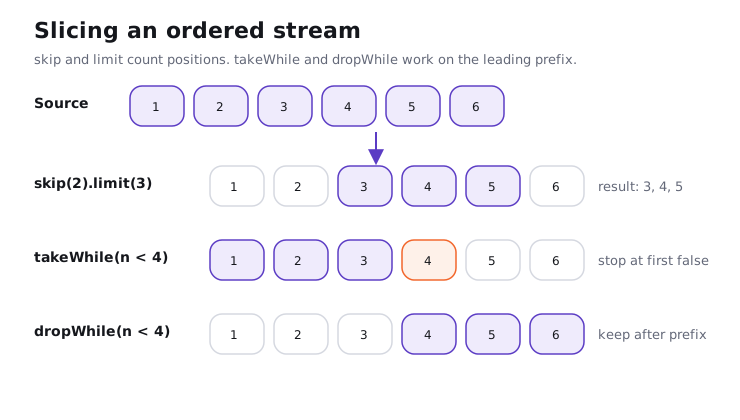
Picture a line of customers at a counter. skip(3) lets the first three leave without service, then the rest continue. limit(3) serves the next three customers and closes the counter. takeWhile(customer -> customer.hasTicket()) serves the front run of ticket-holders and stops at the first person without a ticket.
The phrase front run matters. takeWhile and dropWhile are about prefixes, not "all matching elements anywhere". If you want all matching elements, that is still filter.
A stream of ordered elements is sliced by skip to drop the first two, limit to keep the next three, takeWhile to keep the leading passing prefix, and dropWhile to remove that same prefix
02skip and limit under the hood: counters with encounter order
Both skip and limit are intermediate operations. They do not do anything until a terminal operation asks for elements. In a sequential ordered stream, the mental model is two counters: one counter discards the first skip elements, and another counter stops after limit accepted elements.
Try it yourself first
Before reading the output, calculate both lists. Then change the order in your head and see why the result changes.
import java.util.List;
import java.util.stream.IntStream;

final class SkipLimitOrderDemo {
    public static void main(String[] args) {
        List<Integer> first = IntStream.rangeClosed(1, 8)
                .skip(2)
                .limit(3)
                .boxed()
                .toList();

        List<Integer> second = IntStream.rangeClosed(1, 8)
                .limit(3)
                .skip(2)
                .boxed()
                .toList();

        System.out.println(first);
        System.out.println(second);
    }
}
The output is:
[3, 4, 5]
[3]
Notice three things.
skip(2).limit(3)means "drop two, then take three".limit(3).skip(2)means "take three, then drop two from that small slice".- Both operations care about encounter order when the stream has one, such as a
ListorIntStream.rangeClosed.
Negative arguments are not allowed. skip(-1) and limit(-1) throw IllegalArgumentException, which is better than quietly producing surprising slices.
03Pagination: readable, but not magic
For in-memory lists, the classic stream pagination line is:
List<Order> pageItems = orders.stream()
        .skip((long) page * size)
        .limit(size)
        .toList();
That is clear for small collections and one-off admin screens. It stops being enough when the source is large or remote. A stream over 1,000,000 sorted orders still has to advance past the skipped prefix before it can return the page.
Try it yourself first
If page = 10_000 and size = 50, how many elements are skipped before the first element of the page can be emitted?
import java.util.List;
import java.util.stream.IntStream;

final class PaginationCostDemo {
    public static void main(String[] args) {
        int page = 3;
        int size = 4;

        List<Integer> items = IntStream.rangeClosed(1, 30)
                .skip((long) page * size)
                .limit(size)
                .boxed()
                .toList();

        System.out.println(items);
    }
}
The output is:
[13, 14, 15, 16]
For page 10,000 with size 50, the skipped count is 500,000. In a database, do not stream every row to the JVM and then call skip. Push pagination to the query with an indexed order, or use keyset pagination when deep pages matter.
skip(page * size).limit(size) is O(page * size + size) element advances for an ordered sequential stream. Page 0 with size 50 advances about 50 elements. Page 10,000 with size 50 advances about 500,050 elements. The code is tidy, but the work is still linear in the offset.
Premium lesson
Keep reading with the Java Pass
The rest of this lesson is part of Java One-Stop Interview Prep: in-depth explanations, diagrams, model answers and how to say them in the interview.
- limit as the safety belt for infinite streams
- takeWhile and dropWhile: prefix operations since Java 9
- Ordered, unordered and parallel behavior
- How to break from forEach
- How to say it in the interview
From ₹199 · one-time payment · No auto-renewal