

Parallel streams: when they help and hurt
How Java parallel streams split work, when the NQ model predicts a win, and why ordering, boxing, collectors, shared state and blocking I/O often erase it.
On this page
🧵 What is a parallel stream?
A parallel stream is a stream whose terminal operation may process different parts of the source on different worker threads. Calling parallel() does not start work by itself; it marks the pipeline so the terminal operation can split the source and run fork-join tasks. Think of a grocery inventory count: one person can walk every aisle, or four people can each count a section and combine their totals.
For this lesson, we'll focus on the decision interviewers actually care about: when parallel streams help, when they hurt, and what the JDK is doing under the hood. We'll connect to How a stream pipeline executes for laziness and sinks, findFirst vs findAny and short-circuiting for ordered short-circuiting, Stream.reduce and summing numbers for associative reductions, and peek, forEach and side effects for side-effect traps. Deeper fork-join scheduling is covered in the Concurrency module.
Below the line (out of scope)
- We will tune stream-shaped CPU work, not build a general concurrency framework.
- We will use Java 21 behavior and call out where the API contract is looser than today's implementation.
- We will not re-teach stream laziness, one-shot streams or collector basics.
- We will not use parallel streams for blocking web calls. That belongs with executors,
CompletableFutureor virtual threads.
The 30-second answer
Use a parallel stream when the source splits cheaply, the data set is large enough, each element does meaningful CPU work, the operation is stateless and associative, and the result can be merged cheaply. A useful rule of thumb is the NQ model: N elements times Q cost per element should be comfortably above about 10,000 small operations before you expect a win. ArrayList, arrays and IntStream.range split well; LinkedList, Stream.iterate and BufferedReader.lines split poorly. Ordered operations such as limit, findFirst, forEachOrdered and sorted add coordination, and unordered() can help only when your business rule truly does not care about encounter order. Avoid boxing, shared mutable state, blocking I/O in the common pool, and naive System.nanoTime() benchmarks.
What you’ll learn
- Explain how
parallel()uses a Spliterator, fork-join tasks andForkJoinPool.commonPool() - Use the NQ model to decide whether
N * Qis large enough to pay for parallel overhead - Rank stream sources by splitting quality, including
ArrayList, arrays,IntStream.range, sets,LinkedList,Stream.iterateandBufferedReader.lines - Spot order-sensitive operations such as
limit,findFirst,forEachOrderedandsortedthat make parallel work coordinate - Avoid shared mutable state, accidental boxing, costly collector merges and blocking I/O in the common pool
- Benchmark candidates with JMH, not one-off
System.nanoTime()loops
01Picture it first: dividing a warehouse count
Picture a warehouse count. If each shelf can be cut into equal ranges, four counters can work independently and add their numbers at the end. If the shelves are a single narrow hallway, or if everyone must report in exact shelf order, the coordination can cost more than the help.
That is the parallel stream trade-off. Splitting and merging are work too. Parallelism helps only when the saved per-element work is larger than the overhead you introduced.
A parallel stream splits an indexed source into chunks, processes them on fork-join workers, and merges partial results into one answer
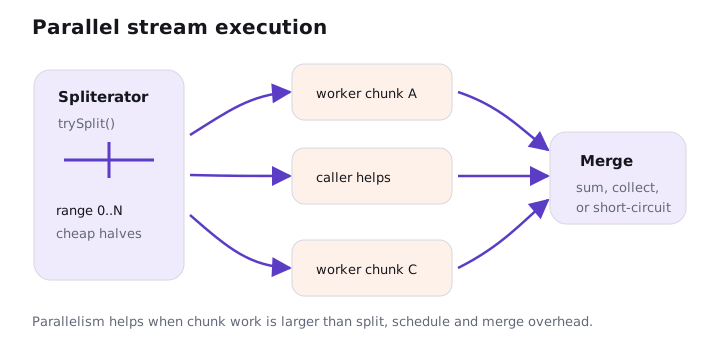
Notice three pieces. The source Spliterator decides how well work can be divided. The fork-join pool runs tasks, including the calling thread while it waits. The terminal operation decides how expensive the merge is.
02Parallel streams under the hood
parallel() is a flag on the pipeline. The source is still lazy, and no worker touches an element until a terminal operation such as sum, collect, findAny or forEach begins. At that point the JDK asks the source Spliterator to split with trySplit() until tasks are small enough to process.
Premium lesson
Keep reading with the Java Pass
The rest of this lesson is part of Java One-Stop Interview Prep: in-depth explanations, diagrams, model answers and how to say them in the interview.
- The NQ model: enough work per element
- Source splittability and order costs
- Advanced: collectors, boxing and shared state
- Measuring without fooling yourself
- How to say it in the interview
From ₹199 · one-time payment · No auto-renewal