

Choosing the right collection
A decision guide for choosing Java collections by lookup, membership, order, sortedness, FIFO, LIFO, priority, index access, thread safety and uniqueness.
On this page
- Picture it first: a routing table, not a family tree
- Start with the operation under the hood
- The default four, and when to leave them
- Worked scenarios interviewers actually ask
- Order is not one thing
- Thread safety changes the answer
- More scenario answers in one table
- Advanced: asking better requirement questions
- How to say it in the interview
🧰 What does "choose the right collection" mean?
Choosing the right collection means picking the interface and implementation whose contract matches the operation you need to make cheap. If you need lookup by ISBN, use a Map; if you need "have I seen this ID?", use a Set; if you need FIFO jobs, use a Deque or a blocking queue. The class name comes after the access pattern.
For this lesson, we'll focus on a decision guide you can use in interviews and production: key lookup, membership, uniqueness, index access, insertion order, sorted order, FIFO, LIFO, priority, reference identity and thread safety. We'll use the Module 3 defaults (ArrayList, HashMap, HashSet, ArrayDeque) and show exactly when to move off them.
Below the line (out of scope)
- The full hierarchy behind these choices: The collections hierarchy
- Operation costs in table form: Big-O cheat sheet for collections
- Implementation internals: How HashMap works, How ArrayList works and Queue, Deque and ArrayDeque
The 30-second answer
Start by naming the operation that must be fast. Key lookup means HashMap; membership and uniqueness mean HashSet; index access and append-heavy ordered data mean ArrayList; FIFO or LIFO at the ends means ArrayDeque. If order matters, pick the kind of order: insertion order uses LinkedHashMap or LinkedHashSet, access order uses LinkedHashMap, sorted order and nearest-key queries use TreeMap or TreeSet, and priority removal uses PriorityQueue. For enum-only keys or values, use EnumMap or EnumSet; for reference-equality keys, use IdentityHashMap. For shared mutation, do not wrap a random collection and hope: use ConcurrentHashMap, a BlockingQueue, CopyOnWriteArrayList for listener-style reads, or a deliberate lock around the whole compound action.
What you’ll learn
- Start from the operation that must be fast, not from a memorized class name
- Choose among the four defaults:
ArrayList,HashMap,HashSetandArrayDeque - Move to
LinkedHashMap,LinkedHashSet,TreeMap,TreeSet,EnumSet,EnumMaporPriorityQueuewhen the requirement changes - Answer scenario questions such as FIFO jobs, enum roles, sign-up order, nearest price and reference-equality keys
- Separate ordering requirements: insertion order, access order, sorted order, priority order and encounter order
- Pick thread-safe collections deliberately:
ConcurrentHashMap, blocking queues, copy-on-write lists and synchronized wrappers - Explain the trade-offs and caveats:
LinkedListrarely wins,PriorityQueueiteration is not sorted, andIdentityHashMapis not value equality
Interview radar
Asked very often: Which collection would you use for lookup by ID, deduplication, FIFO jobs, sorted scores or top-K?
Senior rounds probe: Distinguishing insertion order from sorted order, explaining why PriorityQueue iteration is not sorted, and refusing LinkedList as the default queue.
Production angle: A data structure that was fine at 1,000 items becomes the hot path at 1,000,000 items because the required operation was O(n).
01Picture it first: a routing table, not a family tree
Picture a call-routing menu. The first question is not "which class do you like?". It is "what must this code do most often?" After that, the answer narrows quickly: key lookup, membership, ordering, indexing, end operations, priority or concurrency.
Use this flowchart when an interviewer gives you a scenario. You can draw it in 45 seconds, then talk through trade-offs.
A decision flowchart starts with the operation that must be fast and routes to HashMap for key lookup, HashSet or LinkedHashSet for membership and uniqueness, ArrayList for index access, ArrayDeque for FIFO or LIFO, PriorityQueue for priority, TreeMap or TreeSet for sorted navigation, and concurrent collections for shared mutation
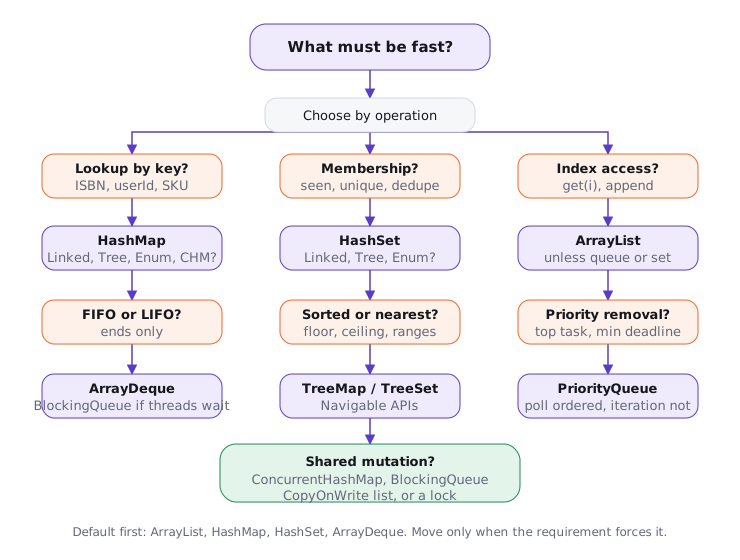
The flowchart is deliberately biased toward defaults. Start with ArrayList, HashMap, HashSet and ArrayDeque. Move away only when the requirement says to.
02Start with the operation under the hood
Try it yourself first
Before reading the table, choose a collection for each requirement: product by SKU, unique roles, signup order without duplicates, next higher price, undo actions and shared hit counters.
| Requirement | Pick | Why | Move off when |
|---|---|---|---|
| Lookup by key, such as ISBN to book | HashMap<K,V> |
expected O(1) get/put |
need sorted keys (TreeMap), insertion/access order (LinkedHashMap), enum keys (EnumMap), shared writes (ConcurrentHashMap) |
| Membership or deduplication | HashSet<E> |
expected O(1) contains/add |
need first-seen order (LinkedHashSet), sorted order (TreeSet), enum values (EnumSet) |
| Ordered data with index access | ArrayList<E> |
O(1) get(i), amortised O(1) append |
many removals through a held iterator, many concurrent reads with rare writes (CopyOnWriteArrayList) |
| FIFO jobs on one thread | ArrayDeque<E> |
O(1) operations at both ends | producers/consumers must block (BlockingQueue) |
| LIFO stack | ArrayDeque<E> |
push, pop, peek, no Stack legacy |
need concurrency or bounded blocking |
| Always remove smallest or largest priority | PriorityQueue<E> |
O(log n) offer/poll, O(1) peek |
need sorted iteration (TreeSet/sort a copy), priority updates by key (custom heap + map) |
| Sorted keys or nearest higher/lower | TreeMap<K,V> / TreeSet<E> |
O(log n) navigation | need concurrent sorted map (ConcurrentSkipListMap) |
| Preserve insertion order with keys | LinkedHashMap<K,V> |
hash lookup plus predictable iteration | need access-order LRU (new LinkedHashMap<>(..., true)) |
| Fixed enum set of flags | EnumSet<E extends Enum<E>> |
bit-vector backed, compact and fast | values are not enum constants |
| Reference-equality keys | IdentityHashMap<K,V> |
uses ==, not equals |
normal business identity or value equality is required |
| Shared mutable map | ConcurrentHashMap<K,V> |
safe individual operations plus atomic compute/merge |
need a compound invariant across several collections |
Notice the pattern. Hash structures buy expected O(1) by giving up sorted order. Tree structures buy sorted navigation for O(log n). Linked variants add iteration order to hash tables for a few extra pointers per entry.
import java.util.HashMap;
import java.util.HashSet;
import java.util.Map;
import java.util.Set;

public class FastOperations {
    record Book(String isbn, String title) {}

    public static void main(String[] args) {
        Map<String, Book> byIsbn = new HashMap<>();
        byIsbn.put("978-0134685991", new Book("978-0134685991", "Effective Java"));
        System.out.println(byIsbn.get("978-0134685991").title());

        Set<String> seenRequestIds = new HashSet<>();
        if (seenRequestIds.add("req-17")) {
            System.out.println("process once");
        }
    }
}
This is the cleanest interview answer: name the operation, name the interface, name the implementation, then give the cost. You do not need to recite every collection class.
03The default four, and when to leave them
ArrayList for lists
Use ArrayList when you need ordered data, index access or append-heavy collection building. A no-arg ArrayList allocates its backing array lazily and grows by about 1.5x, so appending is amortised O(1). Reads by index are O(1).
Move off ArrayList when the requirement is not really "a list". If you only need membership, use a set. If you remove from the front repeatedly, use ArrayDeque. If multiple threads read while rare writes update a listener list, consider CopyOnWriteArrayList, knowing that every write copies the array.
HashMap for key lookup
Use HashMap for a business key to value lookup: user ID to user, ISBN to book, SKU to stock count. It gives expected O(1) lookup and update with a good hashCode. We cover the internal table, load factor and tree bins in How HashMap works.
Move off HashMap when you need a guarantee it does not give. Insertion order means LinkedHashMap; sorted keys and range queries mean TreeMap; enum keys mean EnumMap; shared updates mean ConcurrentHashMap; reference identity means IdentityHashMap.
HashSet for membership and uniqueness
Use HashSet for "have I seen this?" and "keep one of each". Set.add returning false is a useful first-time-seen check. HashSet is backed by a HashMap, so the same equality and hashing caveats apply.
Move off HashSet when order is part of the output. First-seen order means LinkedHashSet; sorted unique values mean TreeSet; a fixed set of enum constants means EnumSet.
ArrayDeque for ends
Use ArrayDeque for stack and queue operations in one thread: addLast/removeFirst for FIFO, push/pop for LIFO. It is resizable-array backed, avoids per-node allocation, and does not carry the legacy Vector API that Stack inherits.
Move off ArrayDeque when the queue is a concurrency boundary. A producer-consumer problem with waiting on empty or full queues wants BlockingQueue, such as ArrayBlockingQueue for bounded capacity or LinkedBlockingQueue when configured with a bound. A priority scheduler wants PriorityQueue or PriorityBlockingQueue, not FIFO.
04Worked scenarios interviewers actually ask
These are phrased like scenario questions because that is how they show up. The nuance is where candidates win or lose points.
FIFO jobs: ArrayDeque, not LinkedList
Try it yourself first
You are implementing a single-threaded job scheduler where jobs are processed in the order they were added. Which collection do you use?
import java.util.ArrayDeque;
import java.util.Deque;

public class FifoJobs {
    public static void main(String[] args) {
        Deque<String> jobs = new ArrayDeque<>();
        jobs.addLast("email");
        jobs.addLast("invoice");

        while (!jobs.isEmpty()) {
            System.out.println(jobs.removeFirst());
        }
    }
}
Use ArrayDeque. Many multiple-choice questions list LinkedList as the expected FIFO answer because it implements Queue, but in modern Java I want you to say the better default. LinkedList allocates a node per element and pointer-chases through memory; ArrayDeque keeps references in a circular array and is the usual in-memory queue choice.
If producers and consumers run on different threads and must wait, the answer changes to BlockingQueue. That is a different requirement, not a different opinion.
Fixed enum roles: EnumSet
If roles are a closed enum such as ADMIN, USER, AUDITOR and GUEST, use EnumSet<Role>. It is compact because it represents membership with bits based on enum ordinal, and it is type-safe because it cannot contain a role from another enum.
import java.util.EnumSet;

public class RolesExample {
    enum Role { ADMIN, USER, AUDITOR, GUEST }

    public static void main(String[] args) {
        EnumSet<Role> staff = EnumSet.of(Role.USER, Role.AUDITOR);
        System.out.println(staff.contains(Role.ADMIN)); // false
        staff.add(Role.ADMIN);
        System.out.println(staff); // [ADMIN, USER, AUDITOR]
    }
}
Use HashSet only when the values are not enum constants or the domain is open-ended. For enum-keyed maps, the sibling answer is EnumMap<Role, Permission>.
Sign-up order plus uniqueness: LinkedHashSet
If you need user IDs in the order they signed up and no duplicate IDs, use LinkedHashSet. ArrayList preserves order but permits duplicates. HashSet enforces uniqueness but does not promise iteration order.
import java.util.LinkedHashSet;
import java.util.Set;

public class SignupOrder {
    public static void main(String[] args) {
        Set<String> signups = new LinkedHashSet<>();
        signups.add("u3");
        signups.add("u1");
        signups.add("u3");
        signups.add("u2");
        System.out.println(signups); // [u3, u1, u2]
    }
}
This is also the right answer for "deduplicate while preserving first appearance". In Java 21, LinkedHashSet is a SequencedSet, so it also gives you first, last and reversed views.
Nearest higher or lower price: TreeMap through NavigableMap
For a stock or marketplace price ladder where you need the closest price above or below a target, use NavigableMap, usually implemented by TreeMap. HashMap can find an exact key, but it has no concept of nearest key.
import java.util.NavigableMap;
import java.util.TreeMap;

public class PriceLadder {
    public static void main(String[] args) {
        NavigableMap<Integer, String> byPrice = new TreeMap<>();
        byPrice.put(100, "basic");
        byPrice.put(150, "plus");
        byPrice.put(250, "pro");

        System.out.println(byPrice.floorEntry(180));   // 150=plus
        System.out.println(byPrice.ceilingEntry(180)); // 250=pro
    }
}
Say NavigableMap in the interface and TreeMap as the implementation. That tells the interviewer you know the operation (floorEntry, ceilingEntry) and the engine (red-black tree, O(log n)).
Reference-equality keys: IdentityHashMap
If two different objects that happen to be equals() must remain different keys, use IdentityHashMap. It compares keys with == and hashes them with System.identityHashCode, which is useful for object graph traversal, serialization handles, proxy maps and cycle detection.
import java.util.IdentityHashMap;
import java.util.Map;

public class IdentityKeys {
    public static void main(String[] args) {
        String a = new String("tenant");
        String b = new String("tenant");

        Map<String, Integer> counts = new IdentityHashMap<>();
        counts.put(a, 1);
        counts.put(b, 2);

        System.out.println(a.equals(b)); // true
        System.out.println(a == b);      // false
        System.out.println(counts.size()); // 2
    }
}
Do not use this for normal domain lookup. Most business keys want value equality, so HashMap is the right answer. IdentityHashMap is a specialist tool.
05Order is not one thing
The word "ordered" is overloaded. In interviews, make the interviewer choose the kind of order.
| Order requirement | Collection | Example |
|---|---|---|
| Keep insertion order | LinkedHashMap, LinkedHashSet |
users in signup order |
| Keep access order | LinkedHashMap with accessOrder=true |
small LRU cache |
| Sort by natural order or comparator | TreeMap, TreeSet |
leaderboard by score |
| Remove by priority | PriorityQueue |
task with smallest deadline first |
| Keep index positions | ArrayList |
orders.get(17) |
| Reverse an encounter order | Java 21 SequencedCollection.reversed() |
show newest signups first |
A PriorityQueue is the easiest trap. It is not a sorted list. peek() and poll() see the highest-priority item according to the comparator, but iterating the queue walks the heap array in heap order, not sorted order.
Many candidates hear "leaderboard" and say TreeMap<Integer, String>. That can be right for score to player when scores are unique, but scores often tie. A Map cannot store duplicate keys, so you may need TreeMap<Integer, List<Player>>, a TreeSet<Player> with a comparator that breaks ties by player ID, or a heap if you only need top K.
06Thread safety changes the answer
Thread safety is not a decoration you add at the end. It changes the collection and sometimes the whole algorithm.
| Shared requirement | Prefer | Why |
|---|---|---|
| Many threads update counts by key | ConcurrentHashMap<K, LongAdder> or merge |
atomic per-key operations |
| Producers and consumers wait | BlockingQueue<E> |
put/take can block |
| Many readers, rare writes to listeners | CopyOnWriteArrayList<E> |
iteration sees a stable snapshot |
| A full invariant across several structures | explicit lock or higher-level design | one thread-safe collection is not enough |
| Read-only sharing | List.copyOf, Set.copyOf, Map.copyOf |
immutable snapshot, no locks needed |
import java.util.concurrent.ConcurrentHashMap;
import java.util.concurrent.ConcurrentMap;

public class SharedCounters {
    public static void main(String[] args) {
        ConcurrentMap<String, Integer> hits = new ConcurrentHashMap<>();
        hits.merge("/home", 1, Integer::sum);
        hits.merge("/home", 1, Integer::sum);
        System.out.println(hits.get("/home")); // 2
    }
}
The broken version is get, add one, then put. That is three operations and two threads can interleave. Use merge, compute or putIfAbsent when the compound action is per key.
Cost names should be precise. ArrayList.get(i) is O(1), HashMap.get(k) is expected O(1), TreeMap.floorEntry(k) is O(log n), and PriorityQueue.poll() is O(log n). For 1,000,000 sorted keys, O(log n) is about 20 comparisons; for a front removal from an ArrayList, O(n) can mean shifting nearly 1,000,000 references.
07More scenario answers in one table
Use this table as interview practice. Each answer starts with the collection, then the reason and the caveat.
| Scenario | Collection I'd choose | Nuance to say out loud |
|---|---|---|
| Book lookup by ISBN | HashMap<String, Book> |
ISBN is the key; do not scan a list |
| Product names, no duplicates | HashSet<String> |
if display order matters, switch to LinkedHashSet |
| Student IDs unique and sorted | TreeSet<Integer> |
O(log n), natural order, no duplicates |
| Game leaderboard by score | TreeMap<Integer, List<Player>> or TreeSet<Player> |
ties decide the design |
| Process tasks by priority | PriorityQueue<Task> |
iteration is not sorted; poll is priority order |
| Cache keys compared by reference | IdentityHashMap<Object, Value> |
specialist map using ==, not equals |
| Entries vanish when keys are no longer referenced | WeakHashMap<K,V> |
value must not strongly reference the key |
| Shared map updated by many threads | ConcurrentHashMap<K,V> |
use atomic methods for check-then-act |
| Playlist with middle inserts | usually ArrayList; LinkedList only with a held ListIterator |
walking to the middle dominates LinkedList |
| Producer waits when full | bounded BlockingQueue, such as ArrayBlockingQueue |
ArrayDeque does not block |
| Fixed roles from an enum | EnumSet<Role> |
compact and type-safe |
| Sign-up order plus uniqueness | LinkedHashSet<UserId> |
first appearance wins |
| Closest lower and higher price | NavigableMap<Integer, Quote> via TreeMap |
use floorEntry and ceilingEntry |
| Undo stack | ArrayDeque<Action> |
use push/pop, not Stack |
One subtle row is the playlist. LinkedList only wins when you already hold the node position as a ListIterator, then insertion or removal there is O(1). If you start from an index each time, it still walks O(n), and ArrayList often wins in practice because shifting a contiguous array is cache-friendly.
08Advanced: asking better requirement questions
When a prompt says "fast", ask "fast for which operation?" A collection cannot optimize everything at once. Hash tables optimize equality lookup. Trees optimize ordered navigation. Arrays optimize index access and compact iteration. Queues optimize removal policy.
Here are the follow-up questions I ask before committing:
- Do I need exact lookup or nearest lookup? Exact goes hash. Nearest goes tree.
- Is order part of correctness or only presentation? Presentation can sort a copy at the edge.
- Can duplicates exist? If not, use a set or a map key.
- Is equality value-based, enum-based or reference-based? That selects
HashMap,EnumMaporIdentityHashMap. - Who mutates it? One thread, many threads, or nobody after construction.
- Is the size bounded? Unbounded maps and queues become memory bugs.
- Do I need to remove arbitrary elements or only ends/top? That separates list, deque and heap.
A compact chooser in code
You can encode the reasoning as comments next to your fields. It sounds small, but it prevents future maintainers from "simplifying" the collection into the wrong one.
import java.util.ArrayDeque;
import java.util.Deque;
import java.util.HashMap;
import java.util.LinkedHashSet;
import java.util.Map;
import java.util.NavigableMap;
import java.util.TreeMap;

public class OrderBookState {
    private final Map<String, Integer> quantityBySku = new HashMap<>();
    private final LinkedHashSet<String> signupOrder = new LinkedHashSet<>();
    private final NavigableMap<Integer, String> priceBands = new TreeMap<>();
    private final Deque<String> retryQueue = new ArrayDeque<>();

    void recordSignup(String userId) {
        signupOrder.add(userId); // unique, first-seen order
    }

    String nearestHigherBand(int price) {
        Map.Entry<Integer, String> entry = priceBands.ceilingEntry(price);
        return entry == null ? null : entry.getValue();
    }
}
The field type communicates the contract. NavigableMap says callers may rely on navigation. LinkedHashSet says both uniqueness and insertion order matter. That is better than declaring everything as concrete types by habit.
When the default is wrong
The default four are strong, but they are not magic.
| Default | Wrong when | Replacement |
|---|---|---|
ArrayList |
repeated front removal or end-only queue operations | ArrayDeque |
ArrayList |
membership check is the hot path | HashSet plus a list if order is also needed |
HashMap |
sorted range query is required | TreeMap / NavigableMap |
HashMap |
iteration order must be stable | LinkedHashMap |
HashSet |
first-seen order is required | LinkedHashSet |
HashSet |
values are enum constants | EnumSet |
ArrayDeque |
cross-thread handoff with waiting | BlockingQueue |
PriorityQueue |
you need to update priorities by key frequently | map plus custom heap/index, or a different algorithm |
The production version of this lesson is usually a slow report or a memory leak. A report keeps List<Order> and calls contains for every imported ID, making a nested scan. A cache uses HashMap with no eviction and grows forever. A queue uses LinkedList because it was in a tutorial, then allocates millions of nodes per minute. The fix is not clever code; it is picking the data structure that matches the operation and bounding the data when it can grow without limit.
09How to say it in the interview
When I ask "which collection would you use?", I'm listening for a decision process. A strong candidate starts with the dominant operation, names the interface, names the implementation, gives the complexity, and then states the condition that would change the answer.
In the interview
"I choose collections from the operation that has to be cheap. If I need lookup by a key, I start with HashMap; if I need membership or dedupe, HashSet; if I need index access and append-heavy order, ArrayList; if I need FIFO or stack behavior at the ends, ArrayDeque. Then I adjust for the requirement: LinkedHashMap or LinkedHashSet for insertion order, LinkedHashMap access order for LRU, TreeMap or TreeSet for sorted and nearest-key queries, PriorityQueue for priority removal, EnumSet or EnumMap for enum domains, IdentityHashMap for reference-equality keys, and ConcurrentHashMap or BlockingQueue when shared mutation or handoff is the real requirement. I avoid Vector, Stack and Hashtable in new code, and I do not use LinkedList as the default queue."
On the whiteboard
Start with the hot operation
key lookup       -> HashMap
membership       -> HashSet
index access     -> ArrayList
FIFO / LIFO      -> ArrayDeque
insertion order  -> LinkedHashMap / LinkedHashSet
access order     -> LinkedHashMap(..., true)
sorted / nearest -> TreeMap / TreeSet (Navigable*)
priority removal -> PriorityQueue, poll is ordered, iteration is not
enum domain      -> EnumSet / EnumMap
reference keys   -> IdentityHashMap
shared updates   -> ConcurrentHashMap, BlockingQueue, COW list or explicit lock
defaults: ArrayList, HashMap, HashSet, ArrayDeque
move only when a requirement forces it